Voiceflow is a platform for designing, testing and deploying AI agents. Conversation logic is built on a visual canvas, grounded in your own content, and deployed across web, messaging and voice channels.
At IdealOnlineBusiness, we have looked at what the platform does and how it is sold. One thing to establish up front: Voiceflow does not publish prices, so this review explains what drives the cost rather than quoting a figure we cannot stand behind.
| Pros | Cons |
|---|---|
| Visual builder: non-engineers can build and iterate on flows. | No published pricing: budgeting needs a sales conversation. |
| Knowledge base with retrieval: answers grounded in your own content. | Usage-based billing: harder to forecast than a flat seat price. |
| Multi-channel deployment: one agent across web, chat and voice. | Overhead for solo builders: team structure you may not need. |
| Custom code and API steps: the canvas is not a ceiling. | Simple use cases are cheaper direct: a model API may undercut it. |
| Free trial, no card: build a real agent before talking money. | Quote depends on volume: you need usage data to negotiate well. |
| Agency white-labelling: multi-client workspaces built in. | Third-party price quotes are unreliable: most are out of date. |
Voiceflow is a strong platform whose main friction is commercial rather than technical. Build on the free trial, measure your real interaction volume for a week, and take that number into the pricing conversation. If the volume is small and the use case is single-channel, price the direct API route before committing.
Voiceflow is a visual canvas for designing conversational agents. You lay out flows, prompts and logic without writing the whole thing in code, which lets designers and product people build alongside engineers.
You attach your own documentation, help articles or product data as a knowledge base, and the agent answers from it using retrieval rather than improvising. That is the difference between a demo and something you can put in front of customers.
The same agent can be deployed to a website widget, messaging channels and voice, rather than being rebuilt for each surface. Multi-channel deployment is the main reason teams choose a platform over building directly on a model API.
Voiceflow does not publish a public price list. Billing is described as transparent and usage-based, and businesses are directed to request pricing or book a demo. Budget for a sales conversation rather than a checkout page.
A free trial runs without a credit card, which lets you build and test a real agent before any commercial discussion. Use it to establish your likely usage volume, because that is what the eventual quote will hinge on.
There is a dedicated route for agencies and partners with multi-client workspace management and white-labelling, so agencies can build and run agents for clients under their own brand.
The visual builder is the entry point, not a ceiling. Custom code steps, API calls and integrations mean engineering teams are not blocked by the canvas when a flow needs to do something unusual.
Collaboration, versioning and shared workspaces are central to how the product is organised. If you are one person building one bot, that structure is overhead you will not use.
Voiceflow no longer publishes a public price list, and it is worth stating that plainly rather than quoting figures from older articles that may no longer hold. The company describes its model as transparent and usage-based, offers a free trial with no credit card, and routes businesses to request pricing or book a demo. Agencies and partners have a separate track with multi-client workspaces and white-labelling.
Practically, that means two things. First, any specific monthly figure you find quoted elsewhere should be treated as historical until Voiceflow confirms it for your account. Second, because billing follows usage, the number that determines your cost is conversation or interaction volume, so estimate that before the sales call. Build a working agent on the trial, project your monthly volume from real traffic, and take that figure into the pricing conversation rather than asking what it costs in the abstract.
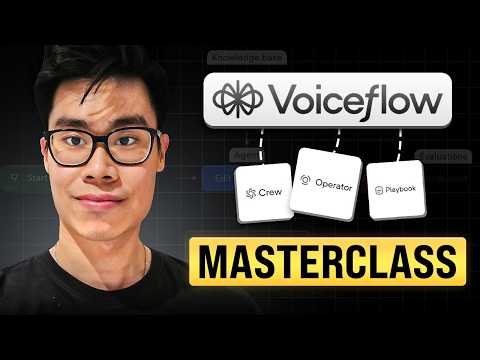
Walkthroughs covering building a first agent on the canvas, attaching a knowledge base, and deploying the same agent to more than one channel.
Voiceflow is a platform for designing, testing and deploying AI agents across channels. These are the areas it covers.
Voiceflow does not publish prices. The model is described as usage-based, there is a free trial with no card required, and businesses are asked to request pricing or book a demo. Agencies and partners have their own route with multi-client workspaces and white-labelling.
We are not going to invent a figure here. Plenty of pages will quote you a monthly price for Voiceflow, and those numbers are either historical or lifted from each other. What we can tell you is what determines the number: usage. Conversation or interaction volume is the meter, so the useful preparation is to build a real agent during the trial, run it against genuine traffic for a week, and extrapolate.
That also tells you whether you need Voiceflow at all. If your volume is low and your use case is simple, building directly against a model API is cheaper. Voiceflow earns its cost when several people need to collaborate on the agent, when it must run across more than one channel, or when an agency is managing agents for multiple clients.
The agent-building market splits between visual platforms, developer frameworks and support-desk bolt-ons.
On this site, our Botpress review covers the closest competitor with public pricing, Collect.chat, reviewed here is the lighter form-style chatbot option, and our Tawk.to review covers plain live chat.


Common questions about Voiceflow, what it builds, how billing works and why there is no public price list.
⚠️ Affiliate Disclosure: This site contains affiliate links. We may earn a commission when you purchase through our links at no extra cost to you. Results are not typical.