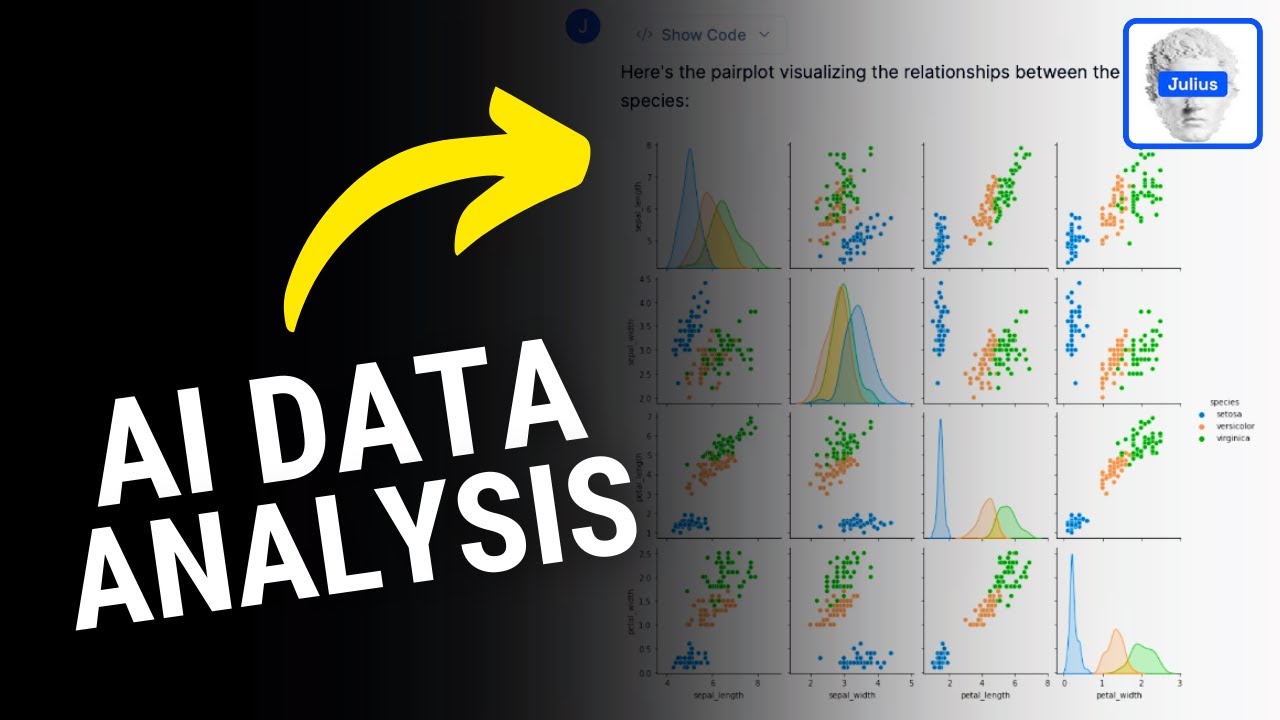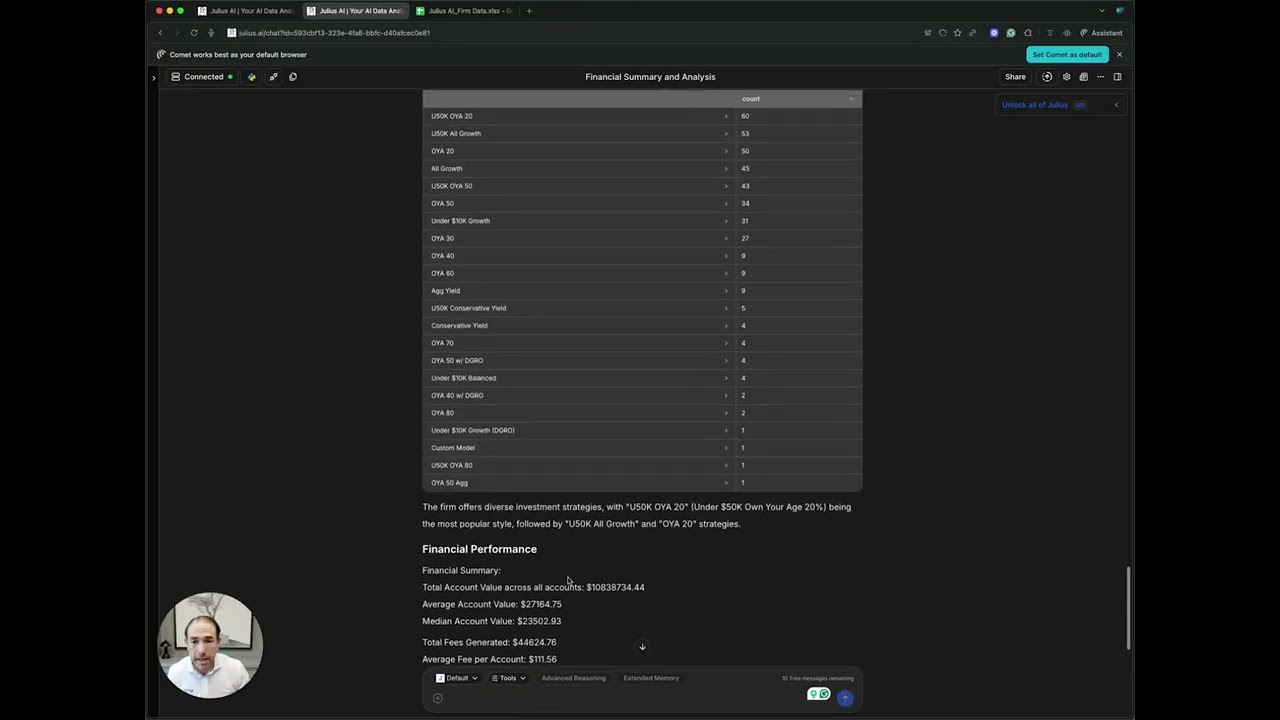
Julius AI is an AI-powered data analyst that lets you upload spreadsheets, CSVs, JSON files, or connect directly to a database, then ask plain-English questions and receive accurate analysis, charts, and written summaries in seconds. Behind the scenes Julius writes and executes Python code, runs statistical tests, generates clean visualizations, and explains results — all without requiring you to know how to code. The platform has grown into a full data workspace with Notebooks for repeatable workflows, team collaboration, direct database connectors (Postgres, MySQL, BigQuery, Snowflake, and more), and a growing library of specialised AI models tuned for different analysis tasks.
Julius is most popular with non-technical business users, marketing teams, researchers, and operations analysts who need data answers fast but do not want to write SQL or Python. Pro plans start at $37/month, with team and enterprise tiers available. Julius scores well on G2 and Capterra for ease of use and time-to-insight, with the most common criticism being occasional hallucinations on edge-case interpretations and timeout errors on very large datasets.
Ask questions about your data in plain English. Julius writes and runs Python under the hood and returns answers as tables, charts, or written summaries — no coding required.
Upload CSV, Excel, JSON, or PDF files, paste data, or connect directly to Postgres, MySQL, BigQuery, Snowflake, and Google Sheets for live analysis.
Julius automatically picks the right chart type for your question — bar, line, scatter, heat map — and generates clean, presentation-ready visualizations in seconds.
Run regression analysis, hypothesis tests, A/B tests, correlations, and significance checks just by asking — Julius picks the right method and explains the results.
Save analyses as Notebooks you can re-run with new data, share with teammates, or schedule. Great for monthly KPI reports and recurring research questions.
Shared team workspaces with role-based access, comment threads on charts, and version history for analyses and Notebooks.
Julius normalizes inconsistent date formats, handles mixed data types, and copes with extra whitespace and encoding issues — the kind of cleanup that usually wastes hours.
Every result comes with a short written summary explaining what was tested, what the chart means, and what assumptions were made — useful for sharing with non-analysts.
Julius bundles a full data-analysis workflow into a chat-based interface: file uploads (CSV, Excel, JSON, PDF), live database connectors (Postgres, MySQL, BigQuery, Snowflake), Python execution under the hood, automated visualization, statistical testing, Notebooks for reusable workflows, team workspaces, version history, and exportable charts and reports. Higher tiers add unlimited messages, larger file/data limits, advanced models (Claude Sonnet, GPT-5 class), priority compute, and enterprise SSO/audit logs. The platform is delivered through a clean web interface with no install required, and a growing mobile companion for reviewing dashboards on the go.
To help you decide whether Julius AI is the right data-analysis tool for you, we have curated four hand-picked YouTube videos covering honest reviews, real client-data demos, and step-by-step tutorials. These videos walk you through uploading a dataset, asking your first analysis questions, generating visualizations, and turning the result into a Notebook your team can re-run.
Julius AI offers a free tier and four paid plans. Free gives 15 messages/month. Plus is $35/month (or $29/mo annual). Pro is $45/month (or $37/mo annual) with no message cap, live database connectors, and Notebooks. Business is $375/month for teams with shared workspaces. Enterprise is custom-priced. Students and educators get 50% off all plans. Annual billing saves 15%.
Julius runs a four-tier pricing structure: Free, Standard, Pro, and Teams. All paid plans are available month-to-month or annually (annual saves about 15%). Below are the current public prices as of 2026.
Limited monthly messages, file uploads up to a small size limit, basic models, and one workspace. Good for trying Julius before upgrading.
Higher message limits, larger file uploads, access to advanced models, faster compute, and email support. Suitable for individual analysts and researchers.
Unlimited messages, large dataset support, all advanced models, Notebooks, version history, priority compute, and database connectors. The most popular plan for working analysts and small teams.
Everything in Pro plus shared team workspaces, role-based access, comment threads, billing consolidation, and admin controls. Ideal for analytics teams of 3 to 30 users.
Single sign-on (SSO), audit logs, custom data residency, dedicated support, and contractual SLAs. Quote on request from Julius sales.
Julius rates 4.5/5 on G2 and 4.6/5 on Capterra, with users praising time-to-insight and ease of use. Trustpilot is more polarised at 2.6/5, mostly driven by billing and refund complaints rather than the product itself. Across independent reviews, the consensus is that Julius is the strongest AI data-analysis tool for non-technical business users in 2026, provided you validate sensitive results before acting on them.

If Julius is not the right fit, the strongest 2026 alternatives are:

Quick answers to the most common questions buyers ask before subscribing to Julius AI in 2026.
⚠️ Affiliate Disclosure: This site contains affiliate links. We may earn a commission when you purchase through our links at no extra cost to you. Results are not typical.