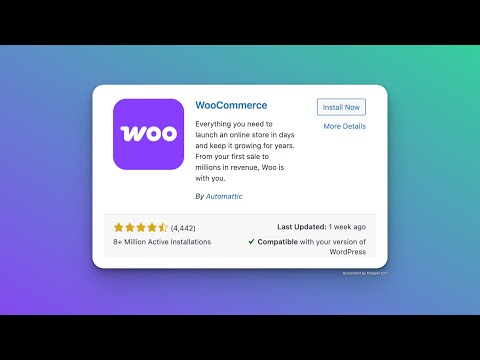
WooCommerce (now branded simply as “Woo”) is the world’s most widely used open-source ecommerce platform — a free WordPress plugin owned by Automattic that turns any WordPress site into a fully featured online store. Powering 4.17 million live stores and processing $30–$35 billion in annual GMV, Woo holds a 20–39% share of the global ecommerce market depending on measurement, making it the #1 platform by store count globally and the dominant ecommerce solution across most European markets.
The core Woo plugin is 100% free with zero licensing fees and zero transaction fees — you only pay for the underlying WordPress hosting (~$5–$50/month), domain ($10–15/year), and any premium extensions or themes you want to add. The Woo extension ecosystem is the largest in ecommerce: 1,200+ official extensions on the WooCommerce Marketplace plus 6,000+ third-party extensions and 59,000+ compatible WordPress plugins. Best for store owners who want maximum control, no platform fees, and the flexibility of self-hosting on WordPress.
The core WooCommerce plugin is free under GPL and free of any licensing or transaction fees forever — only pay for hosting, domain, and any premium extensions you choose.
Powers 4.17M+ live stores and 20-39% of all global ecommerce sites. Largest ecommerce platform by store count worldwide.
1,200+ official extensions on the Woo Marketplace, 6,000+ third-party extensions, plus 59,000+ compatible WordPress plugins — 10x larger than any rival app store.
Unlike Shopify and others, Woo charges zero transaction fees on top of payment processing. Use Stripe, PayPal, Square, or any other gateway with no platform cut.
Open-source code means unlimited customisation — modify themes, hooks, payment logic, checkout flow, anything. No platform restrictions.
Built on WordPress (43% of all websites). Same content management, SEO tools, theme system, and plugin ecosystem you already know if you have used WordPress.
Developed and supported by Automattic — the company behind WordPress.com and Jetpack — with regular updates, security patches, and a long-term roadmap.
Particularly dominant in Italy (#1 with 26% share) and across most European markets — multi-currency, tax compliance, and language localisation built in.
WooCommerce bundles a complete ecommerce platform: free open-source core plugin, product catalog, shopping cart, checkout, order management, customer accounts, coupons, tax automation, shipping zones, multi-currency support, payment gateway integrations (Stripe, PayPal, Square, WooPayments, Klarna, Apple Pay, Google Pay, plus 100+ regional gateways), 1,200+ official extensions, 6,000+ third-party extensions, full WordPress theme compatibility, REST API, headless commerce support, subscriptions and memberships extensions, bookings and appointments extensions, marketplace and multi-vendor extensions, and full code-level customisation freedom for developers.
To help you decide whether WooCommerce is the right ecommerce platform for your store, we have curated four hand-picked YouTube videos covering full beginner tutorials, the install setup wizard, a complete store-build walkthrough, and a Mastering WooCommerce + Elementor combo guide. These walk you through installation, product setup, payment configuration, and launching your first store.
WooCommerce core plugin is 100% free and open source. Total store cost depends on: WordPress hosting ($5-$250/month for shared to managed), domain (~$15/year), SSL (typically free via Let’s Encrypt or hosting), payment processor fees (Stripe/PayPal ~2.9%+30c), premium extensions ($20-$250/year each — Subscriptions $259/year, Bookings $259/year, Table Rate Shipping $99/year). Startup stores: $50-$100/month. Large stores: $3,000+/month. Annual total: $100 to $10,000+ depending on scale.
The core WooCommerce plugin is free. Total store cost depends on hosting, domain, and the premium extensions you choose to install. Below is a typical 2026 cost breakdown.
The core plugin is 100% free under GPL. Includes product catalog, cart, checkout, order management, customer accounts, coupons, basic shipping, and basic tax tools.
Required to run WooCommerce. Options range from budget shared hosting (Hostinger, Bluehost) at ~$5/month up to managed WooCommerce hosting (Cloudways, WP Engine, Pressable) at $30–$50/month.
Required for a professional store URL. Standard .com / .net / .store domains run $10–$15/year through Namecheap, Cloudflare Registrar, or your hosting provider.
Free SSL via Let’s Encrypt — included on virtually all modern hosting providers.
Most stores end up buying 3–10 premium extensions for advanced features (payments, shipping, marketing, automation). Typical premium extension is $49–$249/year.
Simple store: $100–$300/year. Mid-size store with extensions: $500–$2,000/year. Larger store with full premium stack: $2,000–$5,000/year. No platform fees, no transaction fees on top.
WooCommerce is widely covered by G2, Capterra, and the WordPress.org plugin directory. Users consistently praise the customisation freedom, no transaction fees, and the massive extension ecosystem. Critical reviews focus on performance overhead and self-hosting maintenance burden. For store owners who want maximum control and platform-fee-free ecommerce on top of WordPress, Woo remains the most-recommended 2026 platform.

If WooCommerce is not the right fit, the strongest 2026 ecommerce platform alternatives are:







Top Rated Features


Top Rated Features


Quick answers to the most common questions buyers ask before choosing WooCommerce in 2026.
⚠️ Affiliate Disclosure: This site contains affiliate links. We may earn a commission when you purchase through our links at no extra cost to you. Results are not typical.