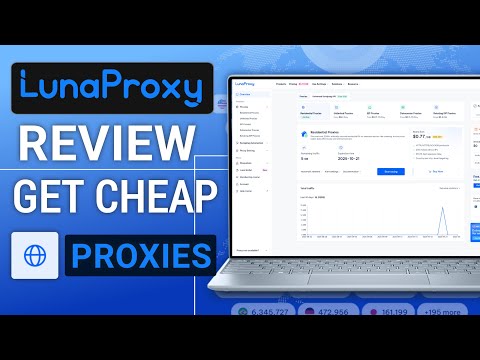
LunaProxy is a residential proxy provider offering one of the largest proxy IP pools in the budget tier — the company advertises 200M+ residential IPs sourced from real devices across 195+ countries. The platform is built for web scraping, SEO research, ad verification, social media account management, market intelligence, sneaker/copping, and brand protection at scale. Pricing starts at $0.65–$0.77 per GB on the residential plan, putting LunaProxy among the most affordable serious residential proxy providers.
LunaProxy supports city- and ISP-level geo-targeting, multiple authentication methods (user:pass and IP whitelist), HTTP(S) and SOCKS5 protocols, and offers dynamic rotating IPs as well as sticky sessions. Independent reviewers on G2 and proxy comparison sites consistently call out the low price-per-GB, broad country coverage, and 24/7 support as the standout strengths. The main caveats: the advertised “200M IP pool” is generally considered marketing-inflated by independent testers, and IP cleanliness can vary across geographies. Best used with provider-provided sticky sessions and validated for your specific target sites.
LunaProxy advertises a 200M+ residential IP pool sourced from real consumer devices across 195+ countries. While independent testers consider this number inflated, the pool is large enough to deliver consistent rotating residential traffic at scale.
Among the cheapest serious residential proxy providers — pricing starts at $0.65/GB on volume tiers, with mainstream plans around $0.77/GB. Significantly cheaper than Bright Data or Smartproxy for equivalent residential traffic.
City- and ISP-level geo-targeting across all 50 US states and most major international markets. Useful for ad verification, geo-restricted content access, and market intelligence.
Choose between rotating IPs (new IP per request) or sticky sessions (same IP for up to 30 minutes). Sticky sessions are critical for social media accounts and shopping sessions where IP consistency matters.
Full protocol support for HTTP, HTTPS, and SOCKS5. Compatible with virtually every scraping framework, browser, and automation tool.
Two authentication models — username/password credentials or IP whitelist — let you integrate with scraping pipelines, anti-detect browsers, and team workflows flexibly.
In addition to GB-based pricing, LunaProxy offers an unlimited residential plan — useful for very high-volume operators where per-GB billing becomes unpredictable.
24/7 chat and ticket support with technical reps who understand scraping use cases. Independent reviewers consistently rate support response speed as a standout.
Below is a quick rundown of LunaProxy’s headline features. The platform’s edge is price: at $0.65–$0.77/GB, residential proxies are dramatically cheaper than Bright Data and Smartproxy — useful for cost-sensitive workloads where IP cleanliness can be tested per use case.
Watch these hand-picked LunaProxy walkthroughs to see signup, residential proxy setup, and anti-detect browser integration before you buy. Coverage includes 2025/2026 reviews, safety analysis, and step-by-step IP setup tutorials.
LunaProxy uses GB-based pricing for residential proxies plus a separate unlimited plan. Datacenter and mobile proxies have their own pricing schemes. The headline residential prices below are the publicly listed rates; volume tiers and promotional rates can lower per-GB costs further.
LunaProxy offers a free trial / starter credit so you can test the IP pool and authentication on your actual target sites before paying. Validate IP cleanliness for your specific use case during the trial.
Rotating residential IPs billed per GB consumed. Promo and volume pricing can push the effective rate below $0.65/GB on high-volume plans; mainstream pricing sits around $0.77/GB.
Static residential and ISP IPs are sold per-IP per-month for long-running connections (account management, session continuity). Pricing varies by country and is shown at checkout.
Pay a flat fee for unlimited bandwidth over a fixed validity period. Useful for very high-volume operators who’d otherwise burn through GB-based pricing fast.
Datacenter proxies are sold per-IP at low cost; mobile (4G/5G) proxies are premium-priced for highest-trust use cases like ad verification and social media automation.
Reviews on G2 and Proxyway consistently highlight low price-per-GB, broad country coverage, and responsive support as LunaProxy’s standout strengths. Reviewers and independent testers caution that pool-size claims should be verified for your specific country/use case, and recommend always testing on a small trial budget before scaling.
Comparing LunaProxy with other residential proxy providers? These alternatives compete on pool size, pricing, or premium features:

IOctopus is a server-side tracking and conversions API solution that helps performance marketers and advertisers track conversions accurately in the cookieless era. In this IOctopus review by IdealOnlineBusiness.com, we look at its pricing, features, integrations, and ease of use based on public reviews and user feedback. Whether you run paid ads on Google, Meta, TikTok, or Pinterest, IOctopus promises reliable conversion tracking, server-side tagging, and improved ROAS visibility.
Our analysis of IOctopus shows the platform is trusted for bypassing ad blockers, recovering attribution lost to iOS 14.5+ ATT restrictions, and centralizing server-side tracking across multiple ad platforms. It holds a 4.7/5 rating across user reviews. Users praise the no-code setup, GTM compatibility, and pixel matching accuracy, while some flag the learning curve for advanced server containers. For DTC brands and agencies serious about attribution, IOctopus is a strong choice.
Explore More





Top Rated Features






Looking for a working Proxy-Seller coupon code? Use SAJID15 at checkout to get a verified 15% discount on Proxy-Seller residential, ISP, datacenter and mobile proxies. We negotiated this exclusive Proxy-Seller promo code directly with the brand, and we re-test it regularly so it actually works when you paste it.
The SAJID15 discount code is intended for purchases made through our link and applies at checkout across Proxy-Seller self-service plans. If a specific bundle rejects the code, contact their 24/7 support or reach out to us and we will verify the current terms.
Unlike scraped coupon aggregators listing dead codes, this is a partner code issued to IdealOnlineBusiness.com. Prefer codes applied automatically? Our free IOB Coupons Chrome extension detects Proxy-Seller at checkout and fills the code for you. Comparing providers first? See our WebShare review for a budget alternative with its own 10% code.
⚠️ Affiliate Disclosure: This site contains affiliate links. We may earn a commission when you purchase through our links at no extra cost to you. Results are not typical.